
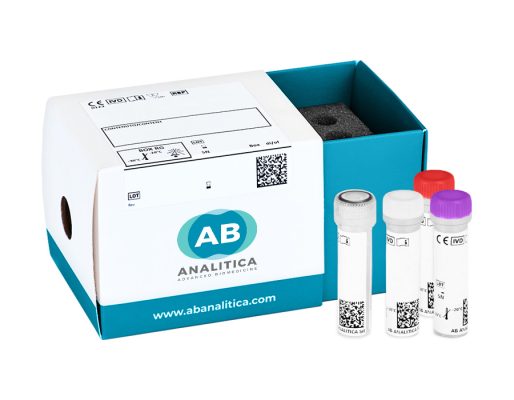
REALQUALITY RQ-BCR-ABL p210 One-Step Kit
The REALQUALITY RQ-BCR-ABL p210 One-Step kit is designed for the detection and quantification
of the t(9;22)(q34;q11) translocation, specifically the p210 transcript.
Using a one-step Real-Time RT-PCR method, the kit provides fast and accurate results for
monitoring Chronic Myeloid Leukemia (CML).
Key Features
- Developed according to the Europe Against Cancer guidelines.
- Includes a dUTP/UNG system to prevent PCR contamination.
- Contains an internal fluorescent normalizer for reliable data output.
- Requires only 5 μL of extracted RNA for each reaction.
- When used with the RQ-BCR-ABL p210 Standard Kit, it allows precise MRD monitoring.
- Shares a compatible thermal profile with other REALQUALITY leukemia kits (e.g., p190).
- Validated on major Real-Time PCR instruments used in diagnostic laboratories.
Clinical Applications
- Detection of the BCR-ABL p210 transcript.
- Monitoring treatment response in CML patients.
- Minimal Residual Disease (MRD) evaluation.
Kit Contents
- Ready-to-use one-step Real-Time RT-PCR reagents.
- Internal control to verify reaction performance.
About AB Analitica
AB Analitica is a leading Italian manufacturer of molecular diagnostic kits.
The company is known for its high-quality standards and innovative technologies.
Its products are widely used in hematology and oncology laboratories worldwide.
Exclusive Distributor in Iran
Fardad Azma Rad Co.
is the exclusive representative of AB Analitica in Iran.
The company provides guaranteed authenticity, specialized technical support,
and expert consultation for clinical and molecular laboratories.


There are no reviews yet.